
Cluster: Rooms, Rates & Accommodation Selection | Content Type: Case Study | Search Intent: Informational
Better hotel room descriptions help travelers choose the correct room by making differences concrete: bed setup, occupancy, size when verified, view, layout, accessibility features, bathroom configuration, inclusions, and meaningful location details. Strong case studies show that effective copy reduces ambiguity instead of adding more adjectives.
Room-copy takeaway
- Describe differences a traveler can use to choose, not generic qualities every room claims to have.
- Keep names, descriptions, photos, amenities, and rate rules consistent across the hotel website and distribution partners.
- Treat missing or uncertain details as a content-quality problem rather than filling the gap with assumptions.
Room copy is a decision tool
Guests often compare several room types within the same property. “Deluxe,” “premium,” and “executive” may have meaning inside the hotel’s inventory system but tell the traveler little without context. A useful description answers the next question: What do I get here that I do not get in the room below it, and does that difference matter for my trip?
Expedia Group’s guidance on improving hotel property listings emphasizes complete, current descriptions, amenity details, and room imagery so travelers can understand the offer and set expectations. The company includes customer examples and internal marketplace data, so any reported performance results should be read in that platform context. The broader editorial lesson is straightforward: specific content supports confident comparison.
Case pattern: replace labels with evidence
A weak description says a room is “spacious, elegant, and perfect for relaxing.” A stronger one states the verified layout and features: one king bed, seating for two, walk-in shower, desk, balcony, connecting-room option, or a defined view category. Not every property should list every detail in the first sentence. The copy should prioritize the features most likely to change the booking decision.
The same rule applies to room names. A guest should not need to decode internal abbreviations or brand terminology before comparing options. If “Ocean View King” and “Oceanfront King” are distinct categories, the difference needs to be explained consistently in text and photography. If the distinction cannot be supported accurately, the naming system may be creating more complexity than value.
Use a repeatable description anatomy
1. Lead with the room’s primary differentiator: view, extra space, separate living area, bed configuration, kitchen, terrace, or another verified feature.
2. State sleeping setup and maximum occupancy clearly, including sofa beds or rollaways only when the policy is confirmed.
3. Add the layout and bathroom features that materially affect choice, such as separate tub and shower, accessible configuration, or second bathroom.
4. Name included amenities that differ from standard rooms, not a long list of items found everywhere in the hotel.
5. Clarify location or access only when it is stable and useful, such as club-floor access or a building wing with a different arrival route.
This structure also supports reducing abandoned bookings. A guest who reaches the rate page but still cannot tell which room to choose may leave to compare the property on another channel. Better descriptions reduce the need to open multiple tabs or contact the hotel for basic distinctions.

Make policy details part of room merchandising
Room descriptions cannot be separated completely from booking rules. Expedia Group’s B2C lodging display requirements call for travelers to see bed-type descriptions, check-in instructions, cancellation conditions, and charges due at the property at appropriate points in the shopping and booking journey. Those are technical integration requirements, yet they highlight a content principle: the room choice, rate choice, and stay conditions should not contradict one another.
For example, “two queen beds” should not appear in the room headline while the booking engine later describes the bed type as a request. A “family room” should not imply a particular occupancy unless the hotel’s actual policy supports it. Accessibility descriptions should state verified features rather than use broad labels that may mean different things to different guests.
Use photos to prove the distinctions
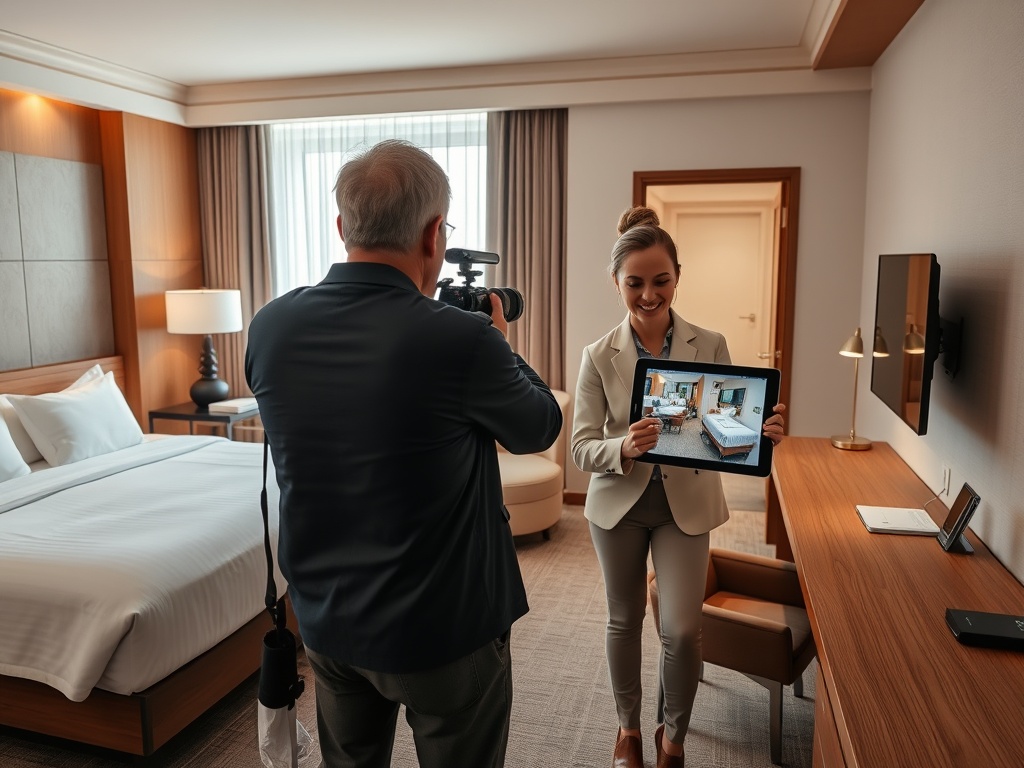
Copy works best when photography supports it. Each room category should have images that show the sleeping area, bathroom, view or balcony where relevant, and the features that justify the category difference. Reusing the same hero image across several room types may simplify production, but it can weaken the guest’s ability to understand what they are buying.
This is part of the broader first-impression design standard for the hotel. The visual language of the room page should match the actual experience. Wide-angle photography can help show layout, but it should not make the room appear materially larger than it is. Descriptions should not compensate for unclear photography with more promotional language.
Create a room-content source of truth
- Assign one owner for the master room inventory, naming, capacity, amenity, and policy data.
- Use a controlled process for updating the hotel website, booking engine, CRS, and major distribution channels after a room change.
- Date-stamp photography and content reviews so renovation, furniture changes, or policy updates are not missed.
- Keep a record of common guest questions; repeated questions often reveal missing content or confusing terminology.
- Verify accessibility claims with the appropriate property and compliance teams rather than copying a generic template.
Measure whether guests are choosing more confidently
Room-content case studies can use behavioral and service signals rather than trying to attribute all revenue change to copy. Useful measures include room-detail engagement, movement between room categories, booking completion by category, call or chat questions about beds and views, post-booking room-change requests, and complaints that the room did not match expectations.
| Content problem | Rewrite direction | Quality check |
|---|---|---|
| All categories sound “luxurious” | Lead with concrete differences | Can a traveler explain the upgrade in one sentence? |
| Bed setup is unclear | State verified bed configuration and request limits | Does booking-engine language match? |
| View names are confusing | Define what each view category actually faces | Do photos support the wording? |
| Amenities are inconsistent | Use one verified source of truth | Are the same details present across channels? |
Localization deserves the same discipline as the master English copy. A translated room name should preserve the actual category difference, and measurements, bed terminology, accessibility language, and policy wording should be adapted carefully rather than translated word for word without context. If the hotel sells through several markets, review the highest-volume language versions alongside the source text. A content system is only as reliable as the versions travelers actually see, and inconsistencies can recreate the same confusion the rewrite was meant to remove.
The arrival experience should confirm the choice. If a guest booked a category because the description emphasized a terrace or club access, check-in should recognize that feature rather than forcing the guest to ask. The work on better arrival and check-in spaces becomes more effective when reservation information is accurate and easy for staff to interpret.
Rewrite the highest-confusion room first
Choose the room category that generates the most pre-booking questions or post-booking changes. Compare its name, description, photographs, amenities, occupancy rules, and rate display across the hotel website and major distribution channels. Fix contradictions before adding promotional copy. A strong room-description case study shows that guests received clearer evidence for a decision, not simply more words.