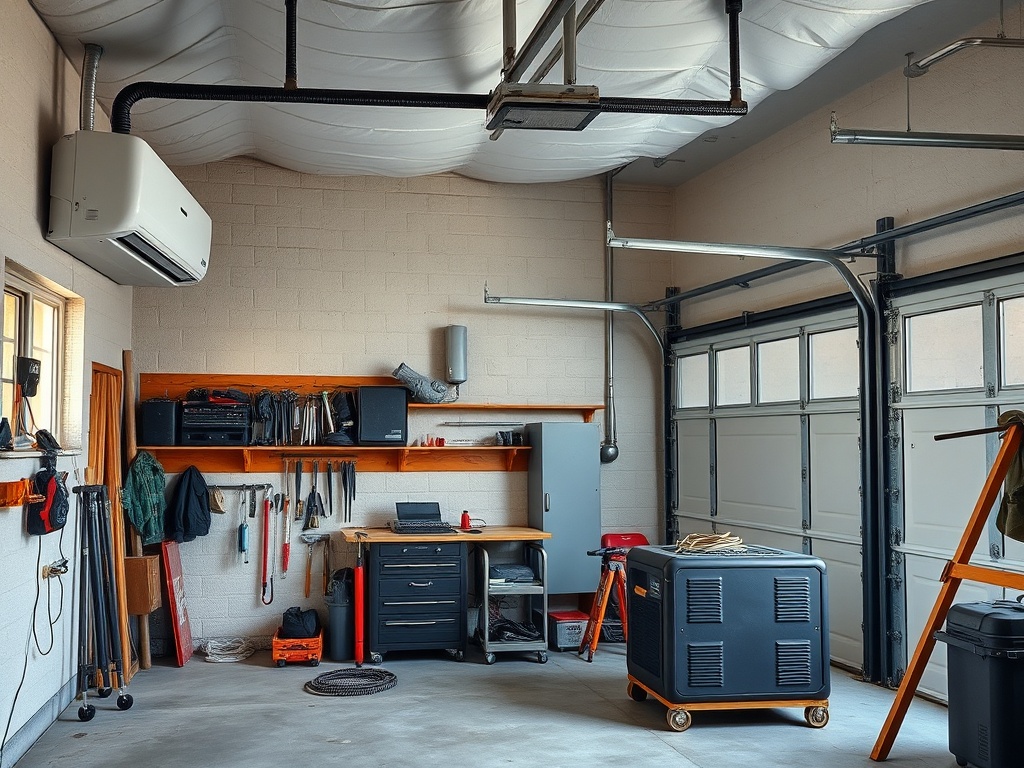

For most garages, the right HVAC choice depends less on the square footage alone than on insulation, air leakage, how often the space is occupied, local winter and summer conditions, and whether the goal is heating only or year-round temperature control. Mini-splits offer zoned heating and cooling, unit heaters concentrate on fast fixed-space heating, and portable equipment trades capacity and efficiency for low commitment and mobility.
Condition the garage only after deciding how it will be used. A well-insulated workshop used several days a week may justify a fixed mini-split or unit heater. A garage used occasionally may be better served by limited spot heating or cooling. Attached garages also require careful attention to air separation, combustion safety, and local code requirements.
Start With the Garage, Not the Equipment Catalog
A garage is a demanding space for temperature control. Large overhead doors leak air. Concrete slabs can stay cold well into spring. Vehicle doors may open repeatedly. Exterior walls and ceilings are sometimes under-insulated compared with the house. Workshops can also generate dust, fumes, or heat that should not be recirculated into living areas.
Before selecting equipment, review the envelope. The principles explained in why insulation and air sealing matter to HVAC performance apply strongly here. Sealing obvious leakage and improving insulation can reduce the load that any heater or air conditioner must handle. It can also make temperature recovery after the overhead door opens more predictable.
A load calculation is preferable to sizing by garage area alone. Ceiling height, door area, insulation levels, design outdoor temperature, solar exposure, and intended indoor temperature all affect capacity. A garage kept at 55 F for winter projects has a different design objective from one expected to feel like a living room.
Mini-Split Heat Pumps: Best for Regular, Zoned Use
A ductless mini-split combines an outdoor heat-pump unit with one or more indoor air handlers. It can heat and cool without extending the home’s duct system into the garage. The U.S. Department of Energy’s overview of heat-pump systems describes ductless air-source heat pumps as a flexible option for spaces without existing ductwork.
For a garage used as a workshop, studio, hobby area, or home gym, a mini-split has several practical advantages. It provides both heating and cooling, can modulate output on many modern systems, and avoids floor space taken by a portable appliance. Because it is fixed equipment, it also offers a cleaner everyday setup once properly installed.
The trade-offs are installation cost and planning. The indoor head needs a suitable wall location and condensate drainage. The outdoor unit needs clear airflow and protection from damage or heavy snow where relevant. Electrical capacity must be verified. In cold climates, low-temperature heating performance should be evaluated from rated data rather than assuming every model delivers the same output at low outdoor temperatures.
Unit Heaters: Strong Heating Without Summer Cooling
A unit heater is a fixed appliance designed primarily to heat a larger open space. Common versions use electricity, natural gas, propane, or hot water, depending on the building. Suspended units can preserve floor space and distribute warm air across a garage more quickly than a small portable heater.
They make the most sense when heating is the dominant need. A mechanic’s bay, woodworking shop, or detached garage in a cold region may benefit from a fixed heater that can recover temperature after a door opening. Electric unit heaters can simplify combustion concerns but may require substantial electrical capacity. Fuel-fired units require proper venting, combustion air, clearances, and code-compliant installation.
A gas-fired heater should never be treated as a simple appliance swap. Garages can contain gasoline, solvents, paint products, batteries, and vehicle exhaust. Ignition-source placement and ventilation rules vary by jurisdiction and building type. Have the proposed equipment and installation reviewed by a qualified contractor and local authority where required.
Portable Systems: Flexible, but Limited
Portable equipment includes electric resistance heaters, portable air conditioners, evaporative coolers in suitable dry climates, and portable heat-pump units. Their appeal is obvious: low initial commitment, no permanent wall-mounted indoor unit, and the ability to store the device when it is not needed.
The limitations are equally important. Portable air conditioners often need an exhaust path. Small electric heaters warm occupied zones more effectively than a large, leaky garage. Evaporative coolers depend strongly on outdoor humidity. Portable combustion heaters introduce carbon-monoxide and fire concerns and may be prohibited or unsuitable for enclosed garages. The U.S. Consumer Product Safety Commission’s home-heating safety guidance reinforces the need for working alarms, correct appliance use, and careful handling of fuel-burning heating equipment.
For occasional use, a portable electric option may be reasonable when the electrical circuit is appropriate and manufacturer clearances are followed. For regular occupancy, repeatedly setting up hoses, cords, or temporary heaters can become less convenient than a properly sized fixed system.
Side-by-Side Comparison
| Option | Best Fit | Main Strength | Main Limitation | Planning Focus |
|---|---|---|---|---|
| Ductless mini-split | Frequently used garage needing heating and cooling | Zoned year-round conditioning | Higher installation commitment | Load, low-temperature performance, drainage, electrical service |
| Fixed unit heater | Cold-climate garage mainly needing heat | Fast dedicated heating | Usually no cooling | Fuel or electrical capacity, venting, clearances, code |
| Portable equipment | Occasional or temporary conditioning | Low commitment and movable | Limited capacity and setup inconvenience | Safe circuit use, exhaust or ventilation, manufacturer instructions |
The comparison is not a ranking. A small insulated garage in a mild climate may need little conditioning, while a large detached workshop can justify more robust fixed equipment. The value of each option changes with usage patterns.
Attached Garages Need Separation From Living Space
Do not solve a garage comfort problem by casually connecting it to the home’s supply and return ductwork. Garages may contain vehicle exhaust, fuel vapors, dust, or chemical contaminants that should not be distributed into occupied rooms. Building and mechanical codes commonly require separation between garages and living areas, but the exact rules vary.
If a heat pump is being considered for the garage, the same planning issues that apply to a whole-home conversion still matter on a smaller scale: electrical capacity, outdoor-unit placement, design load, and cold-weather output. A deeper review of those factors is available in what to know before switching from gas heat to a heat pump.
Garage systems also deserve warranty scrutiny because operating environments can be dusty, humid, corrosive, or exposed to impact. Before paying for extra protection, compare what the base equipment warranty already covers with the terms discussed in should you buy extended HVAC warranty coverage.
Pick the System Around Real Use
A useful decision can be made with four questions: How many hours per week will the garage be occupied? Does it need cooling as well as heat? How good is the envelope? What permanent electrical, venting, or outdoor-unit changes are acceptable? Answer those first, then have a qualified HVAC contractor calculate the load and evaluate safe installation options.
For an occasional workspace, restraint may be the best investment. For a garage that functions as a regular occupied room, a fixed system designed for the actual load usually offers better control than repeatedly asking portable equipment to compensate for a weak building envelope.
Informational disclaimer: This article is for educational purposes and does not constitute professional HVAC, electrical, fire-safety, building-code, structural, or legal advice. Garage equipment, fuel use, ventilation, clearances, and permitted installations vary by property and jurisdiction. Consult qualified professionals for system-specific guidance.